Directional Boring Contractors
Bores under the driveway, the road, the parking lot, or the creek — installed without cutting the surface open and without guessing where the existing utilities sit.
Directional boring is how utilities get installed when open-cut is not an option: a paved road that cannot be closed, a customer's finished driveway, a landscaped campus, a stream bank, or a corridor already crowded with existing facilities.
Eagleway self-performs boring work as a crew, not as a subcontracted line item. The same crew places the tickets, potholes the crossing utilities, drills the pilot, pulls the product, backfills the pits, and hands over the as-built. That matters on short crossings where most of the cost and most of the risk sit in the setup, not the footage.
This page covers shorter crossing work — roads, driveways, parking lots, and creek banks. For long-run mainline drilling, bore planning, and rock crossings, see our horizontal directional drilling page.
Request a quote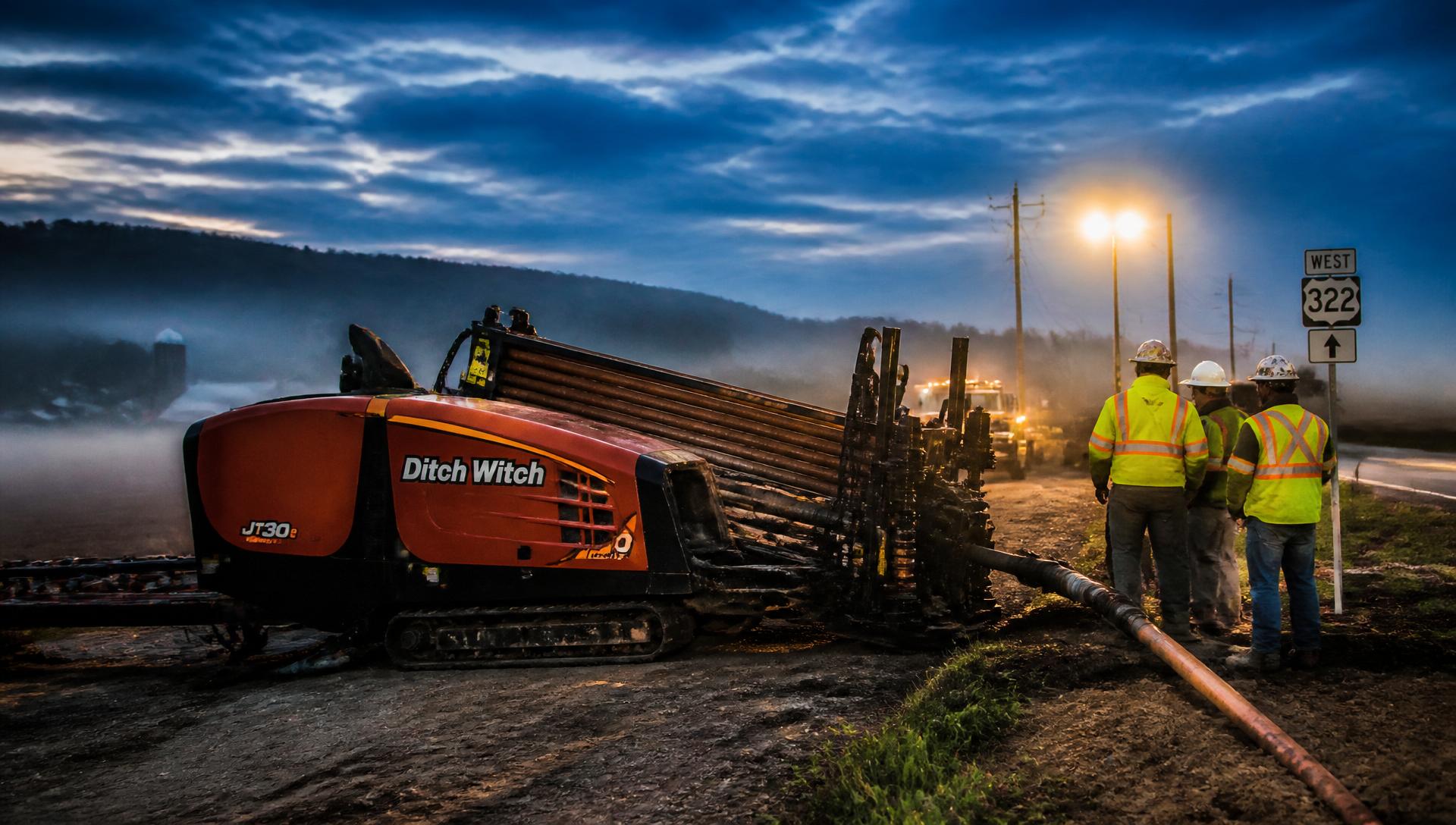
- Typical crossing
- 40–400 ft road, driveway, and lot crossings
- Product
- 1"–8" conduit, HDPE, MDPE gas, water service, electric duct
- Entry footprint
- Compact pits — no trench across the surface being crossed
- Surface restoration
- Pit backfill, compaction, topsoil, seed, asphalt or concrete patch
- Turnaround
- Most single crossings are drilled, pulled, and restored in one day
What we bore
- Fiber and communications conduit
- Electric primary and secondary duct
- Gas service and mainline (MDPE)
- Water and sewer service laterals
- Irrigation and site utility sleeves
- Multi-duct bundles and spare capacity
Why bore instead of trench
Open-cutting a road means saw cutting, excavation, spoil handling, stone, compaction, a permanent patch, traffic control, and a pavement warranty. On most crossings a bore beats that on schedule and total installed cost, and it leaves no settlement scar for the road owner to argue about later.
Boring is also the only realistic answer on finished sites — active parking lots, occupied campuses, and residential frontage where a trench across the driveway is not something the property owner will accept.
Depth, cover, and separation
A bore is only correct if it holds cover the whole way and keeps separation from everything it crosses. We track depth and pitch at every rod, log it, and compare it against the required cover for the road authority and the clearance required from each crossing utility. If the shot cannot hold cover, we redesign the profile rather than pulling product into a bad hole.
- 01
Ticket and mark verification
One-call ticket placed and marks verified on site before mobilization.
- 02
Pothole the crossings
Existing utilities exposed by vacuum excavation and recorded by depth and offset.
- 03
Pit setup and traffic control
Entry and exit pits set, containment staged, and traffic control placed per permit.
- 04
Pilot, ream, pull
Tracked pilot shot, reaming sized to the product, controlled pullback.
- 05
Backfill and restore
Pits compacted in lifts, surfaces restored, site swept and photographed.
- Bore log with depth at each rod
- Pothole record: utility, depth, offset
- As-built drawing
- Restoration photos before and after
How much does directional boring cost?
Pricing is driven by product size, crossing length, soil or rock, access, traffic control, restoration, and how many utilities have to be potholed first — not by footage alone. Short crossings carry most of their cost in setup. Our HDD cost guide breaks down each driver.
How long does a driveway or road bore take?
Most single residential or commercial crossings are potholed, drilled, pulled, and restored inside one working day. Multi-crossing runs are scheduled by the day with production tracked per shot.
Will there be a mess on the property?
Entry and exit pits are the only surface disturbance. Drilling fluid and cuttings are vacuumed and hauled off by our hydrovac crew, pits are compacted and restored, and the work area is swept before we leave.
Do you bore for other contractors?
Yes. A large share of our work is boring under a prime contractor, utility, or engineering firm's scope, including short-notice crossings that stalled somebody else's schedule.
Send us the project details and get a real number.
Eagleway Communications LLC — Edinboro, PA. Serving Pennsylvania, Ohio, West Virginia, and New York.