Underground Utility Construction
Trench to restoration, self-performed: conduit systems, duct banks, vaults and handholes, service laterals, and the compaction and surface work that closes them out.
Underground utility construction is the full scope around the pipe and conduit — excavation, bedding, placement, backfill, compaction, structures, and restoration — done to a spec that will survive inspection and a winter.
Eagleway self-performs that scope for fiber and broadband providers, municipalities, electric and water utilities, engineering firms, and prime contractors. Because we also drill and hydrovac, an underground package does not need three subcontractors and three schedules to get from locate to restoration.
Request a quote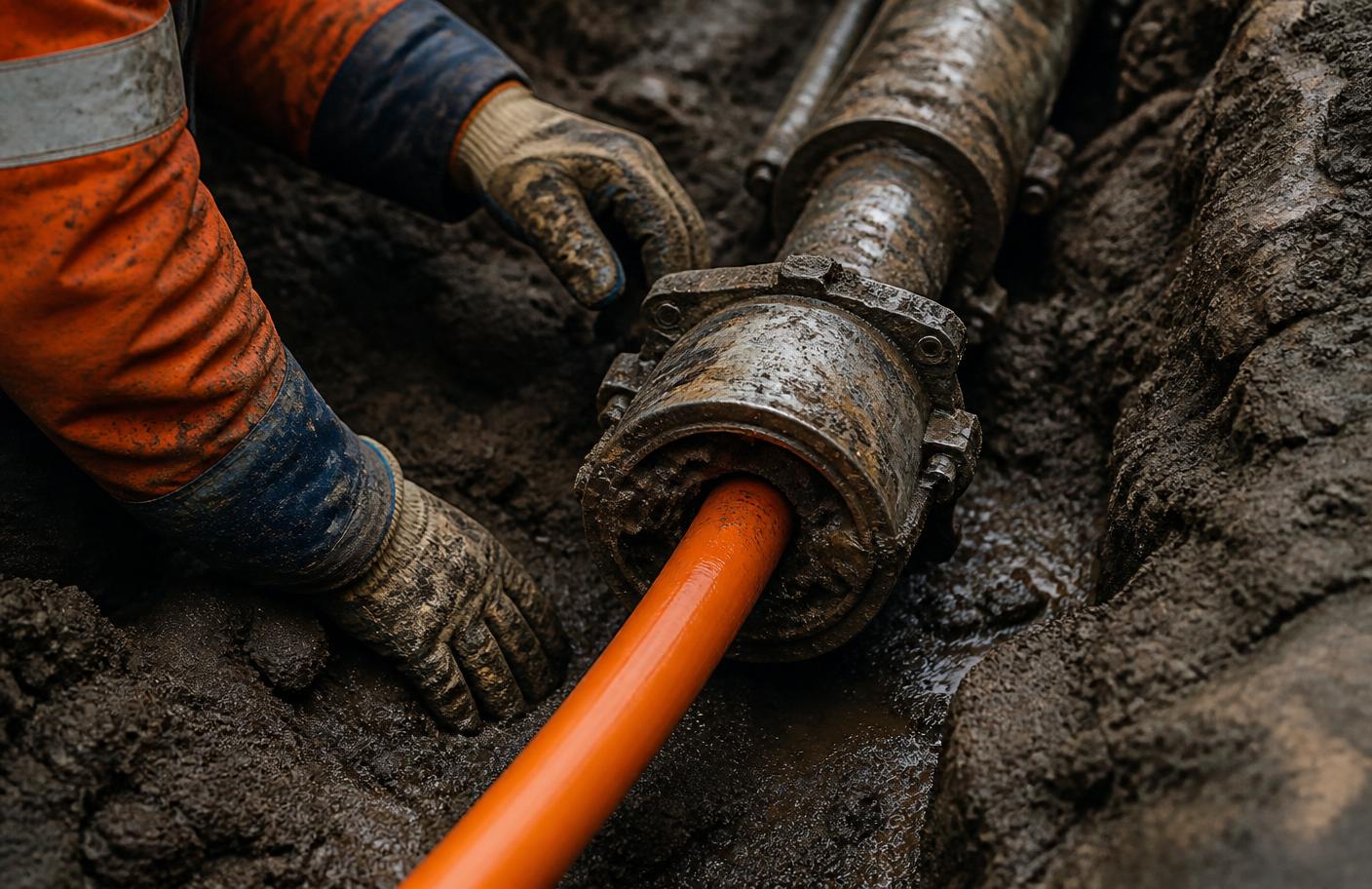
- Installation methods
- Open trench, plow, and trenchless (HDD) on the same project
- Conduit materials
- HDPE, PVC (Sch 40/80), rigid steel sleeves, fabric and rigid innerduct
- Duct configurations
- Single duct, multi-duct racks, concrete-encased duct banks
- Proofing
- Mandrel and proofing pulls, pull rope or tape installed
- Structures
- Vaults, handholes, pull boxes, pedestals, risers
- Backfill
- Bedding, select backfill, flowable fill; compacted and tested in lifts
- Restoration
- Asphalt, concrete, stone, topsoil, seed, and turf
- Coordination
- Locate tickets, permits, inspectors, and owner walk-throughs
Scopes we self-perform
- Conduit systems, innerduct, and duct banks
- Vault, handhole, and pull-box setting
- Service laterals, drops, and building entrances
- Cable and fiber placement support
- Trenching, plowing, bedding, and backfill
- Compaction, grading, and surface restoration
Mixed-method construction
Most real corridors are not all trench or all bore. A run may plow through open field, trench through shoulder, bore under three driveways and a stream, and hand-dig the last section past a gas main. Running those methods with one crew and one foreman removes the handoffs where schedule and quality usually get lost.
Conduit and duct bank installation
Concrete-encased duct banks are unforgiving: the configuration you place is the configuration that gets buried. We build banks on spacers to the specified separation, tie and float-proof the rack so it holds through the pour, maintain the sweep radii the cable requires, and step transitions into structures so the pull path stays within bend limits.
Bored conduit is placed by directional drill where surfaces cannot be opened; trenched conduit gives more control over grade, separation, and duct bank geometry. Most corridors need both, and we run both with the same crew so the transitions are planned rather than improvised.
- Bend radius held for the largest cable that will ever occupy the duct
- Joints fused or solvent-welded per material spec
- Pull rope or measuring tape installed in every duct
- Mandrel/proofing pull to prove a clear, round path
- Spare ducts capped, labeled, and shown on the as-built
- Warning tape and tracer wire placed where specified
Backfill, compaction, and restoration
The part of underground work that gets inspected — and the part that generates callbacks — is what happens after the product is in. We backfill in lifts with the specified material, compact to the owner's requirement, and restore surfaces to the condition the permit demands. Settlement is a warranty problem, and it is cheaper to prevent it than to come back for it.
- 01
Pre-construction
Tickets, permits, traffic control plan, and a walk of the corridor with the owner or inspector.
- 02
Verify existing utilities
Hydrovac potholing at every conflict and crossing before excavation.
- 03
Install
Trench, plow, or bore as the corridor requires; conduit, structures, and product placed to spec.
- 04
Close out
Backfill, compaction, restoration, and final inspection walk.
- 05
Document
As-builts, bore logs, pothole records, and daily reports delivered.
- As-built drawings for the installed corridor, including duct configuration and spare capacity
- Proofing and mandrel results on installed conduit
- Compaction and material documentation where specified
- Daily production and quantity reports
- Restoration photo record
Do you work as a prime or a subcontractor?
Both. We prime smaller underground packages directly for owners and run self-performed underground scopes under general contractors and telecom primes.
Can you handle restoration too?
Yes — backfill, compaction, asphalt and concrete patch, topsoil, seed, and turf are part of the scope we self-perform rather than push to another sub.
Can you install duct bank under an existing paved area?
Bored duct is normally the answer under paved surfaces; concrete-encased duct bank requires open excavation. We frequently combine them — encased bank through the open sections and bored duct beneath the crossings.
Do you install tracer wire and warning tape?
Yes, wherever the owner's spec or state law requires it. It is also a good idea on any nonmetallic duct that someone will have to locate later.
Do you leave spare conduit capacity?
Whenever the design allows. Spare ducts are placed, capped, roped, labeled, and shown on the as-built — spare capacity nobody documented is not spare capacity.
What size projects do you take?
From single service laterals and short conduit runs to multi-mile corridor builds. Short-notice crossings and problem sections that stalled another crew are routine work for us.
Are you insured across all four states?
Eagleway is an insured underground utility contractor working across Pennsylvania, Ohio, West Virginia, and New York. Certificates of insurance are provided with the bid, and we confirm any state or municipal registration required for your specific project before mobilizing.
Send us the utility scope and get a real number.
Eagleway Communications LLC — Edinboro, PA. Serving Pennsylvania, Ohio, West Virginia, and New York.