Horizontal Directional Drilling Contractors
Trenchless crossings under roads, rail, streams, and finished surfaces — planned, tracked, and documented by Eagleway crews on Eagleway iron.
Eagleway Communications is a self-performing horizontal directional drilling contractor working out of Edinboro, Pennsylvania. We drill the crossings that make an underground build possible: road and driveway bores, stream and wetland crossings, rail and highway right-of-way, and long mainline pulls for fiber, electric, gas, and water.
Every bore starts with a plan and ends with an as-built. Before a rod turns we review the locate tickets, the soil and rock expected on the alignment, the utilities we have to cross, the entry and exit angles required to hold cover, and the fluid volumes and containment the site can support. That is what separates a bore that installs clean from a bore that damages someone else's facility.
Request a quote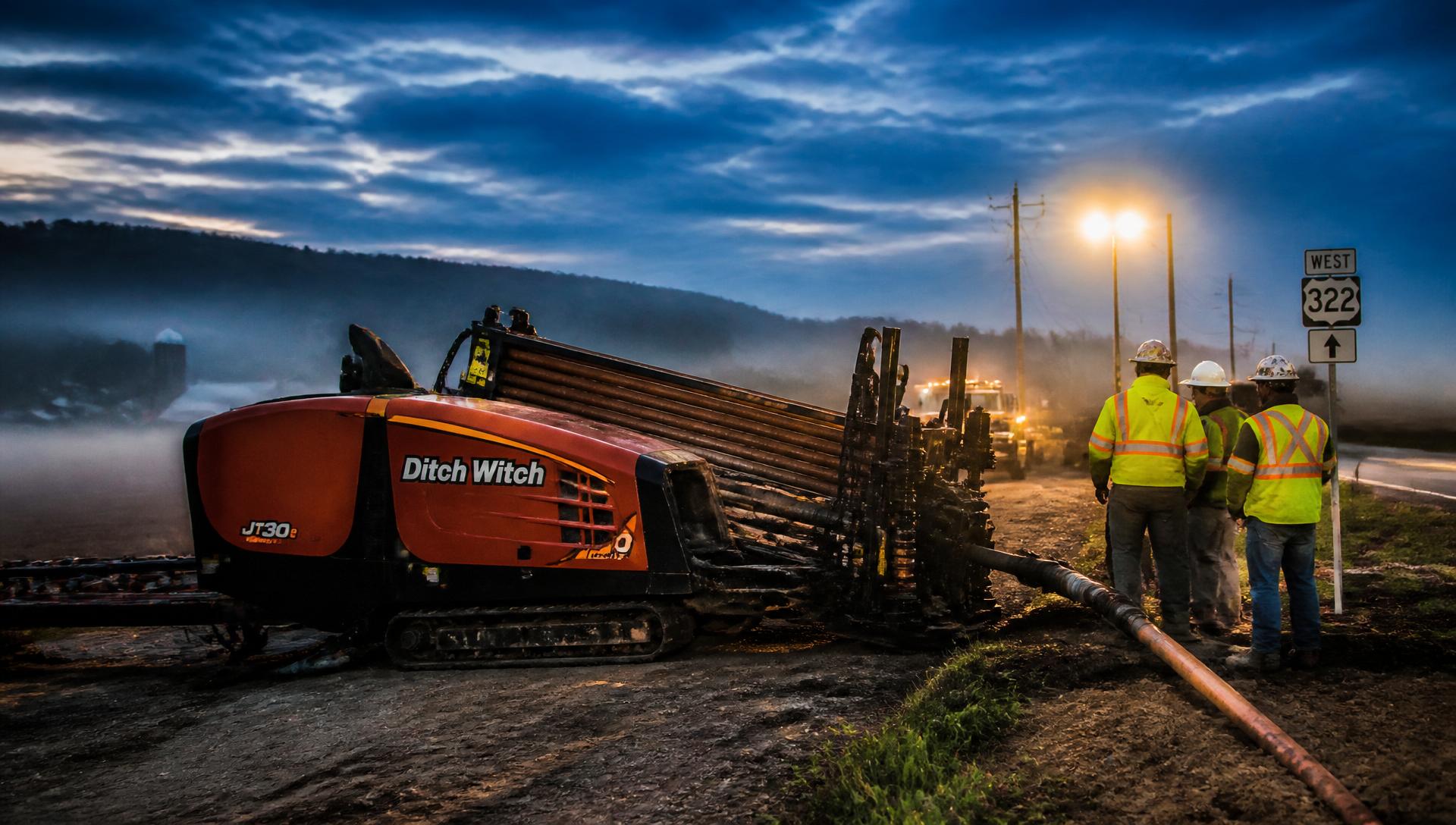
- Bore scope
- Service shots, road and driveway crossings, and mainline pulls
- Product sizes
- 1" service duct through 12" carrier pipe and multi-duct bundles
- Tracking
- DigiTrak walkover locating with recorded rod-by-rod bore logs
- Products installed
- HDPE conduit, innerduct, MDPE gas, fusible PVC, steel casing
- Ground conditions
- Glacial till, clay, wet sand, shale and sandstone (hard-rock tooling)
- Support
- Hydrovac potholing crew mobilized with the drill
Crossings we drill
- State, county, and township road crossings under permit
- Driveway, sidewalk, and parking-lot crossings on finished sites
- Stream, wetland, and ditch crossings with depth-of-cover control
- Railroad and limited-access highway right-of-way
- Long mainline pulls along road shoulders and easements
- Building entrances, laterals, and service drops
Bore planning and fluid management
Bore plans are drawn to the crossing, not the average. We set entry and exit points so the pilot holds minimum cover across the full profile, calculate annular pressure against the depth and soil so we stay below the fracture point, and pre-position containment so any returns are captured rather than chased.
Drilling fluid is mixed to the formation — a clay-cutting blend behaves nothing like what a sand or shale bore needs. Spoils are vacuumed, hauled, and disposed of by our own hydrovac crew, so the site is clean before we demobilize.
Frac-out prevention
Inadvertent returns are the single largest liability on a directional bore. We control them with realistic depth on sensitive crossings, staged pullback pressures, containment staged before the pilot starts, and a written response plan the crew has reviewed at the tailboard. Sensitive crossings get monitored surface walks during the pilot shot.
- 01
Locate and verify
One-call tickets are placed, marks are verified in the field, and every crossing utility is exposed by hydrovac before the pilot shot.
- 02
Bore plan
Entry/exit, rod-by-rod profile, cover, radius, and fluid volumes are calculated for the crossing and reviewed with the owner or inspector.
- 03
Pilot shot
DigiTrak walkover tracking with logged depth and pitch at every rod so the profile can be verified during and after the shot.
- 04
Ream and pull
Reamer sized to the product bundle, controlled pullback pressures, and swivel/breakaway protection on the product.
- 05
Restore and document
Pits backfilled and compacted, surfaces restored, as-built and bore log delivered.
- Rod-by-rod bore log with depth and pitch
- As-built drawing in the owner's requested format
- Photo documentation of pits, product, and restoration
- Locate tickets and permit records
- Daily production reports
How deep can you bore?
Depth is set by the crossing, not the rig. Typical utility bores run 4–10 ft of cover; stream, highway, and rail crossings frequently require more. We set depth from the permit requirement, the utilities being crossed, and the soil's ability to hold annular pressure without a return to surface.
Do you handle the permits?
We prepare and carry the drawings, insurance, and traffic-control detail needed for PennDOT, ODOT, WVDOH, NYSDOT, and municipal right-of-way permits, and we coordinate with the owner or engineer on who pulls them. We do not start a crossing without the permit in hand.
What happens if you hit rock?
Shale and sandstone are normal across the Appalachian Plateau. We plan for it — hard-rock tooling or an air-hammer setup on the pilot, rock back reamers on the pullback, and a drilling mud program built for cuttings removal. See our rock drilling page for how that changes the bore plan and production rates.
Can you work around live utilities?
Yes. Every crossing utility is potholed and physically exposed by our hydrovac crew before the pilot shot, and the exposure is photographed and recorded. We do not bore past a paint mark alone.
Send us the project details and get a real number.
Eagleway Communications LLC — Edinboro, PA. Serving Pennsylvania, Ohio, West Virginia, and New York.