Underground Utility Construction in West Virginia
Steep terrain, shallow rock, and narrow right-of-way — West Virginia bores are planned differently, and pretending otherwise is how crossings fail.
Northern West Virginia — Morgantown, Fairmont, Clarksburg, Wheeling, and the I-79 and I-68 corridors — is active ground for broadband expansion and utility replacement, and it is some of the most demanding drilling terrain in our service area.
Grade, rock, and constrained right-of-way drive everything here. Entry and exit points are limited by where a rig can physically and safely set up; profiles have to hold cover across slopes rather than flat ground; and competent sandstone is often the formation, not the exception.
Request a quote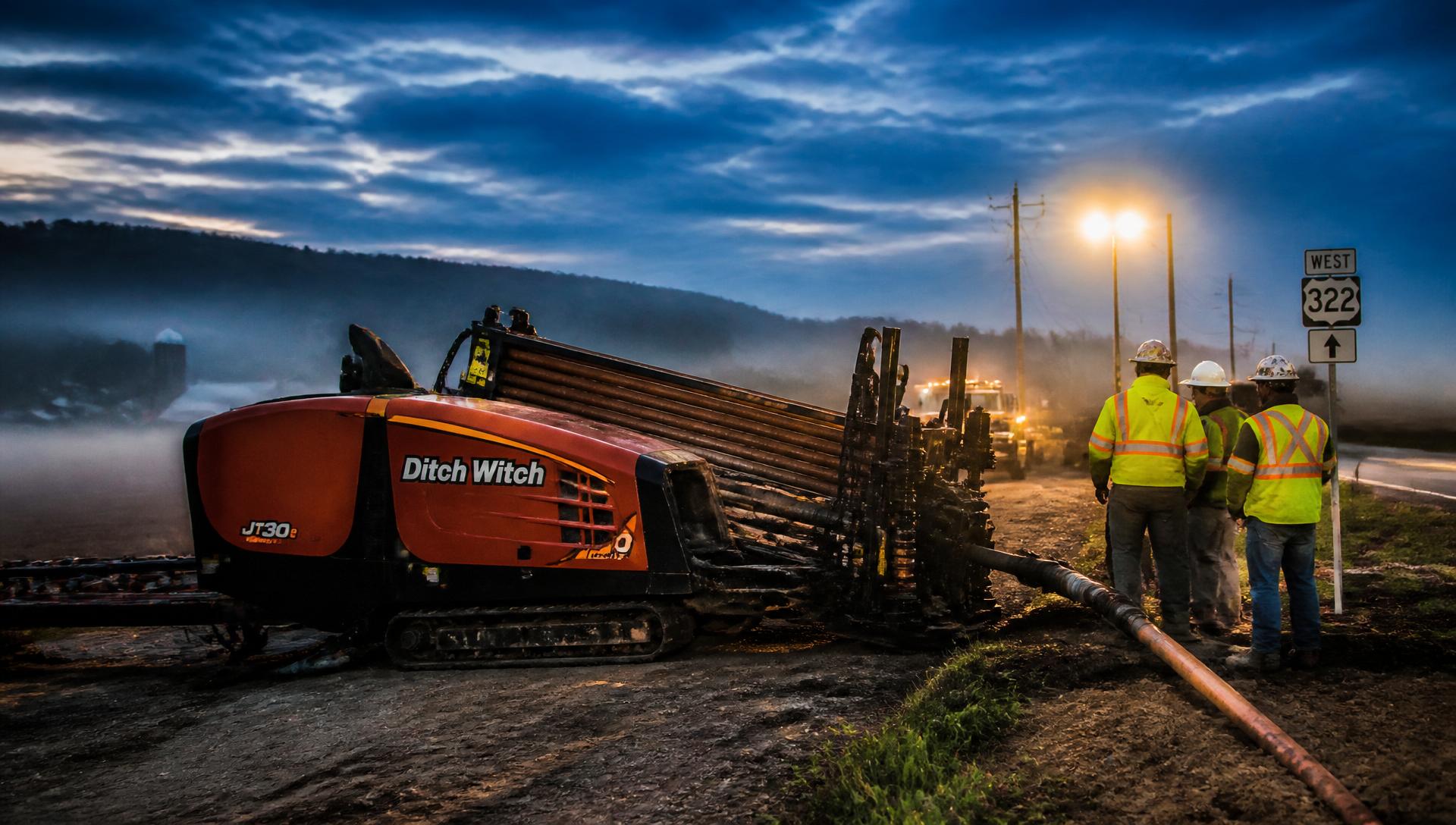
WV811 and excavation notice
West Virginia requires notification to WV811 before excavation, with a mandated waiting period and a tolerance zone around marks. Rural corridors here often carry facilities with limited records, so field verification by vacuum excavation carries even more weight than the marks themselves.
WVDOH right-of-way
Crossings of state-maintained roads require a WVDOH permit with the crossing detail and traffic control. In a state where a large share of roads are state-maintained and shoulders are narrow, traffic control and setup space are frequently the binding constraints on how a crossing gets drilled.
Drilling in Appalachian terrain
Slope changes the geometry of every bore. Cover measured on a flat plan does not survive a hillside, so profiles are drawn against actual grade. Pit placement has to account for equipment stability and fluid containment on a slope, and rock tooling is assumed rather than hoped against. Hollows and stream crossings add environmental containment requirements to the same crossing.
Where we work in West Virginia
- Morgantown and Monongalia County
- Fairmont, Clarksburg, and Bridgeport
- Wheeling and the northern panhandle
- The I-79 and I-68 corridors
- Rural broadband corridors in the northern counties
Do you take rural broadband work in West Virginia?
Yes. Rural conduit corridors with heavy crossing counts and difficult terrain are the kind of work our HDD and hydrovac combination is built for.
How do you price a bore on steep terrain?
Setup and access drive the price as much as footage. We walk the crossing, confirm where a rig can safely set, and price the crossing off the actual profile rather than a plan-view length.
Is rock assumed on West Virginia bores?
Generally yes. Unless boring logs prove otherwise, we plan northern WV crossings as rock bores with the tooling and production rates that implies.
Send us the project details and get a real number.
Eagleway Communications LLC — Edinboro, PA. Serving Pennsylvania, Ohio, West Virginia, and New York.